Overview
Marketing automation in 2026 is no longer about efficiency alone. It’s about control, intelligence, and predictable growth. These marketing automation trends are reshaping how modern marketing teams operate and scale.
- Marketers who heavily invest in automation are experiencing a $5.44 return for every $1 spent, along with an 34% average revenue growth over the last 3 years. Although those numbers are impressive, they also expose a gap.
- Because while budget goes up, many large teams grapple with fragmented data, inconsistent regional execution, and automation that assists activity, but not outcomes.
This guide covers the most impactful trends in marketing automation shaping your team through a consultative approach to emphasis scale, governance, and revenue alignment.
Why Enterprise Marketers Are Re-evaluating Marketing Automation in 2026?
As we all know, the enterprise automation paradox is high ROI with low maturity
Many organizations are already using automation. Yet few would call their setup “optimized” because their tools exist and workflows run. But still siloed insights and reconciliation reporting are their biggest challenge.
From opting for a tool to revenue orchestration, many businesses shifting their thoughts from “which platform should we use?” to “How do we orchestrate the entire revenue engine?”. This is where automation plays a vital role. It’s like a connective tissue between marketing, sales, customer success, and data teams.
What is Marketing Automation?
Beyond email workflows and lead scoring, marketing automation is not a campaign tool but it’s an operational system. Beyond email workflows, lead scoring, and campaign tool, marketing automation is an operational system. It identifies CRM data, behavioural signals, content, channels, and analytics into a single execution layer.
Additionally, marketing automation enable you manage complexity and compliance, and operate across multiple geographies, buyer personas, and regulatory environments. And manual coordination simply doesn’t scale. Leveraging marketing automation trends ensures every team works from the same customer truth, reducing friction, duplication, and misalignment.
At its core, implementing marketing automation technology updates benefits you in several ways:
- Consistent execution across regions
- Real-time performance visibility
- Compliance with data and consent regulations
- Personalization without operational overhead
Best Marketing Automation Tools
|
Tool
|
Best For
|
Key Strength
|
|
HubSpot
|
Scalable Teams
|
Best UI & Unified CRM data.
|
|
Klaviyo
|
eCommerce
|
Deep revenue-tracking & Shopify integration.
|
|
ActiveCampaign
|
Advanced Workflows
|
Visual journey building at a fair price.
|
|
Brevo
|
Budget-Conscious
|
All-in-one features (Email, SMS, Chat) for startups.
|
|
Gumloop
|
AI Power-Users
|
Building autonomous AI agents for marketing tasks.
|
2026 Marketing Automation Trends
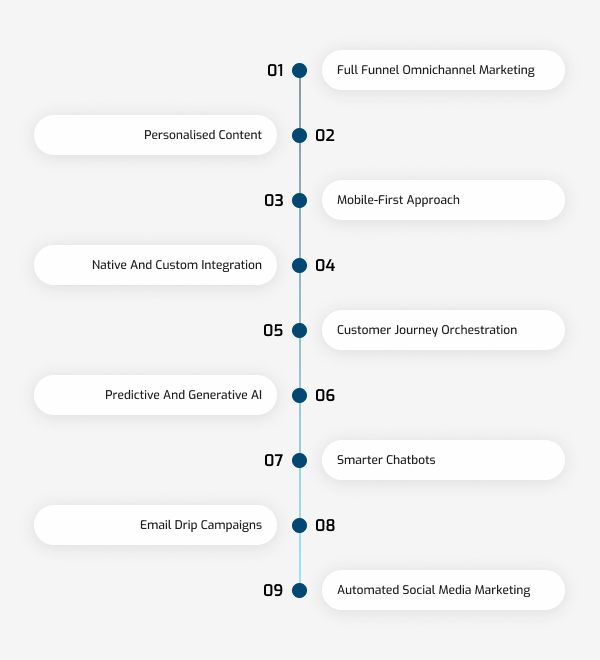
1. AI Powered Hyper Personalization
Using AI for personalized marketing helps organizations move from static segmenting to creating real-time, intent-based experiences. Rather than setting rules in advance, AI uses behavioural signals, firmographics and patterns of engagement to adapt messaging in real-time based on intent.
As a result, if you utilize some of these powerful changes to automate your marketing efforts as an enterprise, you'll see significant business results such as:
- Consistent personalization across regions
- Reduced dependency on manual segmentation
- Better alignment between content and buying intent
2. Predictive Analytics & Lead Scoring
The organization relies on predictive analytics as its core method of operation instead of using it as a temporary solution. The software predicts customer churn while it assesses past results and determines customer lifetime value and identifies leads with high conversion rates and extracts important CRM information. This enables enterprises to easily forecast:
- Which leads are most likely to convert?
- Where pipeline risk exists?
- Which accounts need proactive intervention?
This shifts marketing to another level, moving from reactive reporting to forward‑looking, data‑driven decision‑making.
3. Generative AI for Content and Data
Now, automation platforms are directly embedded with generative AI tools to setup campaign, test, iterate, and create blog posts and video content. This enterprise shift is fine but crucial – AI assists execution, while humans govern strategy and brand integrity. This balance enables speed without sacrificing consistency.
By leveraging Generative AI, you can not only generate an answer to your question, but with a relevant prompt, you’ll get a detailed seo optimized blog in minutes.
4. CRM and Data Syncing as the Core Automation Layer
Now, automation strategies increasingly start with CRM, not the other way around. When CRM and automation platforms are deeply synced, data synchronization becomes a revenue priority:
- Data flows bi-directionally
- Reporting reflects reality, not assumptions
- Sales and marketing operate on shared metrics
From personalised and integrated messaging, social media syncing, CRM integrations to email accounts in sync and more, marketing automation trends makes integration effortless yet seamless to improve interactions with customers and various internal teams of an organisation.
5. No-Code/Low Platforms
The no-code and low-code platforms enable marketers to take control of marketing automation systems which previously required developer expertise. Your team can now build complex workflows with custom apps and integrations using drag-and-drop interfaces which let them avoid traditional IT system delays.
" According to Gartner, 70-75% of new enterprise applications will be built using low-code/no-code by 2026, up from 25% in 2020 – slashing development time by up to 20x (Forrester)."
When you implement these marketing automation trends, you will receive:
- Rapid deployment of custom workflows without coding
- 60% reduction in development costs via citizen development
- Agility to test and iterate campaigns 10x faster
The hands provide control back to marketing teams, accelerating marketing automation updates while the enterprise governance requirements remain intact.
6. Conversational and Voice-Activated Automation
Conversational AI and voice automation are developing chatbots into active engagement systems which work with HubSpot and CRM systems for omnichannel communication pathways. The system provides personalized real-time responses to users through web platforms, WhatsApp, and Alexa voice assistant systems without needing human intervention. GMS reports that chatbots can reduce worldwide customer service expenses by $8 billion every year while they increase customer engagement through their round-the-clock service.
Leveraging this 2026 marketing automation trend means:
- Instant responses across messaging apps and voice channels
- 85% faster lead qualification via context-aware bots
- Unified orchestration tying conversations to revenue pipelines
7. Privacy-First & Consent-Based Marketing
The automated system for privacy protection operates through its fundamental consent management system which conducts automatic compliance testing for GDPR and CCPA regulations while permitting users to gather their personal data. The current platforms conduct automatic preference tagging for users while granting them access revocation rights and treating first-party data as more important than cookies. Organizations will need to comply with 19 U.S. privacy laws by 2026 according to MoEngage while automated consent workflows help brands achieve 31% better results across different channels.
Key wins from these trends in marketing automation:
- Automated consent tracking across 100% of interactions
- 25% uplift in trust-driven personalization
- Risk-free scaling with built-in audit trails
This ensures your marketing automation technology updates build loyalty, not liability, which is essential for global enterprises navigating evolving regulations.
8. Autonomous Omnichannel Orchestration
The global marketing automation market will reach 11 billion dollars by the start of the 2030s according to Statista which makes omnichannel marketing an essential requirement. Marketers want to use one dashboard to handle their multi-channel data operations. The system uses automation to create integrated customer experiences through its omnichannel marketing solution which connects various channels including email and social media and web and SMS and other platforms.
9. Customer Journey Orchestration
Linear funnels no longer reflect how enterprise buyers behave. Fostering customer journey experience requires strategic planning and effort. A company needs a good customer journey orchestration that uses automation to adapt paths based on engagement, trigger actions across teams, and maintain continuity across long sales cycles.
And all of it is possible by implementing the new trends in marketing automation for personalised services and support. When you target specific interests of your customers with the help of bulk email services, CRM and marketing automation, automated email platforms, you’re enabling automation in the customer journey.
10. Predictive and Generative AI Convergence
Predictive AI tells you what’s likely to happen. Generative AI helps you act on it immediately. Together, they enable faster, smarter execution across campaigns and channels.
According to Market.us, the global predictive AI market size is expected to grow to $108 billion by 2033. And guess what? 75% of businesses will adopt or integrate these predictive analytics into their marketing strategies. This will help you get insights into your customer behaviour, purchase history, patterns, and preferences. Also, enable marketers to curate the best quality content. So, businesses like yours can predict their choices to meet their demands.
11. Conversational and Voice Activated Automation
Enterprise chatbots are evolving from support tools into context-aware engagement layers, including integration with CRM, automation, and analytics. They provide consistency without replacing human oversight.
According to gms.net, chatbots save valuable time and minimise your annual customer service costs by up to $8 billion. You can use these chatbots on your website, social channels, and messaging apps to entertain customers in real time. And guess what? It assists with order tracking, responding to customer inquiries, and recommending personalised products.
In addition, you can leverage chatbots during peak hours to handle traffic or when live support is unavailable. Most e-commerce websites use these chatbots to suggest products, order statuses, and more. By integrating chatbots into your marketing automation platform, CRM, and other channels, you can offer exceptional, consistent, and automated user experience across all customer touchpoints.
12. Social Media Automation & Engagement
According to Wisernotify, 68% of marketers consider social media marketing the best platform for generating leads. As of early 2026, there are 6 billion internet users worldwide, with 5.66 billion of them being social media users (Source: Statista). Social media is a powerful community for engaging with your target audience and driving, leads, and its growth is accelerating every year.
This underscores the critical importance of consistent posting on social media, which is where marketing automation truly shines. It allows you to automate or schedule posts for weeks or even months in advance, ensuring no day is missed. This not only saves time and effort but also reduces costs and frees up resources for other crucial areas of your business.
13. Mobile-First Automation Strategies
We can’t deny the importance of the mobile-first mindset. It’s undeniable because 60% of all digital advertising spending is directed to mobile platforms (Source: Statista). From reaching potential customers to measuring a campaign’s effectiveness, converting leads into customers and more.
Mobile-first approach fully understands the users through behaviour analytics by targeting the right audience with real-time segmentation. All this is possible by enabling mobile marketing via automation and analytics tools that encourage mobile-friendly templates for emails, landing pages, personalised messages, etc for the end-users.
As the new trends in marketing automation bring impeccable features, businesses can ensure maximum mobile engagement. Features like push notifications and in-app messages during special offers and introductory promotions increase brand loyalty and boost engagement.
14. Short-form Video Content
With the inception of platforms such as TikTok and Instagram reels, short-form videos have become the door to businesses' marketing their brands. And no wonder video marketing has emerged as the right trend to engage the audience and generate traffic by 82% (Source: Cisco). This marketing automation trend is not only a quest for attention but also a swift, effective method that reflects your brand through visually appealing content to your target audience.
Marketing automation platforms such as HubSpot also make it easier for you to create and share short-form videos, among other things. You can even schedule posts, see the engagement, and analyze your performance metrics. This means that your content is reached to the right people at the right time, enabling swift adjustments via real-time feedback. We can say whether you want to promote product highlights, customer testimonials, or behind-the-scenes peeks, short-form videos can really drive engagement and conversions.
15. Personalized Content Across the Buyer Lifecycle
With the rise of marketing automation and big data, marketers have unlimited opportunities to deliver product recommendations, personalisation and multiple offers to their target audience by analysing and collecting customer data, automating triggered messages, customer segmentation and so much more.
An Adobe study shows 61% of the consumers report that diversity and marketing are both crucial to them while 38% were more likely to patronise brands that ran diverse marketing campaigns than the ones that did not.
Automation enables enterprises to deliver contextual content based on role, maintain personalization, and reduce manual campaign customization to provide the right message using the right channel at the right time. By sending customer-exclusive offers, recommendations based on products, reminders to purchase, and knowing how to retain the customer across all touchpoints, automation does its best to retain customers with personalisation.
16. User Generated Content
User-generated content is increasingly gaining traction and becoming a powerful trend in this competitive business landscape. According to Backlinko 2026, 93% of marketers are unlocking the benefits of user-generated content in their marketing efforts and claim it performs better than traditional methods. Following this, customers are more likely to engage with the content created by their fellow peers. This trend offers a remarkable possibility for marketers to tap into the uniqueness of their customers while decreasing content creation costs.
Using marketing automation, brands can easily curate, manage, and promote UGC across the platforms. Automated requests sent to customers to share either their experiences or products with them may streamline the entire process, allowing more and more users to participate in it. Moreover, showcasing UGC in your campaign not only strengthens community bonds, but it also provides social proof that influences the decisions a potential buyer makes.
Conclusion
Marketing automation has evolved beyond "doing more with less", it's about consistently executing the right strategies to align revenue, data, and customer experience for enterprise teams.
As a certified partner of HubSpot, Salesforce, Pardot, Marketo, and more, we help implement trend-aligned solutions and marketing automation strategy that boost efficiency, eliminate silos, and deliver measurable results, turning automation into a revenue engine that resonates perfectly with your audience.
Ready to Turn Marketing Automation Trends into Results? Book a Strategy Audit !